10 Dating Profile Red Flags That Make Women Swipe Left
Published Wed Dec 24 2025 by Thomas Jentzsch
 AI-generated
Welcome to your essential guide for navigating the modern world of connecting with others. Finding a genuine connection can feel exciting, but it also comes with new challenges.
Carefully crafted profiles and filtered photos can sometimes hide important details. This makes it crucial to know what to look for before you start a conversation.
Our goal is to help you move forward with more confidence and awareness. We have compiled a list of common warning signs based on real experiences and expert insights.
Spotting these indicators is not about being overly critical. It is a smart way to protect your time and emotional well-being. You will learn practical strategies to assess potential matches more effectively.
While this guide highlights patterns often noted by women, the core principles of authenticity and respect are universal. Understanding these cues can help everyone create better profiles and make smarter choices.
Key Takeaways
- Modern platforms have changed how people meet, introducing new challenges in evaluating others.
- Being aware of common warning signs helps protect your time and emotional energy.
- This guide is based on research, expert advice, and real-world experiences.
- Learning to identify these cues benefits everyone in the digital social landscape.
- The focus is on practical strategies for making informed decisions early on.
- Principles of authenticity and respect apply across all platforms and scenarios.
Introduction to Red Flags on Dating Profiles
When browsing through potential matches online, being aware of certain warning signs can save you valuable time and emotional energy. These indicators help you identify potential issues before investing too much effort.
Licensed marriage and family therapist Claudia de Llano explains the challenge:
“The anonymity of dating apps allows people to hide, pretend, string us along, never get back to us, tell us they’re looking for something different than what they really want, and just create plain overwhelm and confusion.”
Warning signs on profiles serve as early alerts for potential dishonesty or incompatibility. They help you avoid situations that might waste your time or even pose risks.
The digital nature of these platforms creates unique challenges. People can more easily misrepresent themselves than in face-to-face meetings.
Remember that a person’s online presence represents their curated best self. If you notice concerning elements in this polished version, the reality might be more problematic.
Spotting these indicators isn’t about being overly critical. It’s a practical approach to protecting your well-being while seeking genuine connections.
| Profile Element | Common Warning Signs | Potential Implications |
|---|---|---|
| Photos | All group shots, heavily filtered images | May hide appearance or lack authenticity |
| Bio Information | Vague responses, contradictory statements | Could indicate dishonesty or uncertainty |
| Communication Style | Immediate intense messages, evasive answers | May signal manipulative behavior patterns |
Research shows that what people claim they want often differs from their actual behavior on these platforms. This makes careful evaluation essential for making informed choices.
Approach profile assessment systematically rather than relying only on intuition. Combine your instincts with concrete observation methods for better decision-making.
Understanding the Importance of Authentic Photos
Your first impression online is built entirely on visuals. Authentic photos are the foundation of trust when connecting with others digitally. They should show what the person actually looks like in daily life.
Research by scholar Lykins found a significant gap between how people appear in curated images and reality. The difference can be as much as 25-40%. This means carefully selected pictures can be misleading.
What to Look for in Profile Pictures
Good profile pictures offer a genuine glimpse into someone’s life. Look for multiple recent photos in different settings. Natural lighting and identifiable backgrounds are positive signs.
A survey of college-aged respondents revealed a key insight. Majorities viewed heavily edited images as less trustworthy. Excessive filtering can raise immediate suspicions.
Spotting Generic or Edited Images
Learn to identify signs of editing. Watch for unnaturally smooth skin or mismatched lighting. Stock-photo aesthetics that look too perfect are often a red flag.
A simple verification method is the three-photo rule. Request one full-body shot, one close-up in natural light, and one showing a real activity. This helps build a complete and honest picture before you meet.
Authentic photos demonstrate confidence and transparency. If a profile only contains flawless, professional images, it’s wise to pause. Requesting clearer pictures is a reasonable step in modern dating.
Male Dating Profile Red Flags, Swipe Left Reasons
Modern dating platforms offer men unprecedented opportunities to showcase their best selves, making poor profile choices particularly telling. With countless resources available, there’s simply no excuse for a subpar presentation.
If someone cannot present themselves well with unlimited time and photo selection, they likely won’t be engaging in person. Women bear responsibility for recognizing and acting on obvious warning signs.
Certain choices immediately signal incompatible values or personalities. Aggressive bios, excessive shirtless photos, or displays of concerning behaviors serve as clear indicators to swipe left.
| Profile Element | Concerning Signs | Better Alternatives |
|---|---|---|
| Photos | Shirtless hunting shots, blurry group pics | Clear, recent photos showing genuine interests |
| Bio Content | Demanding language, negative statements | Positive, specific details about personality |
| Overall Vibe | Appears lazy or low-effort | Shows genuine effort and personality |
The following sections will detail specific categories of warning signs. This comprehensive framework helps women make informed decisions about when to swipe left.
Men reading this can use these insights to improve their own profiles. Avoiding common mistakes increases chances of genuine connections with compatible partners.
Inconsistencies Between Profile Text and Visuals
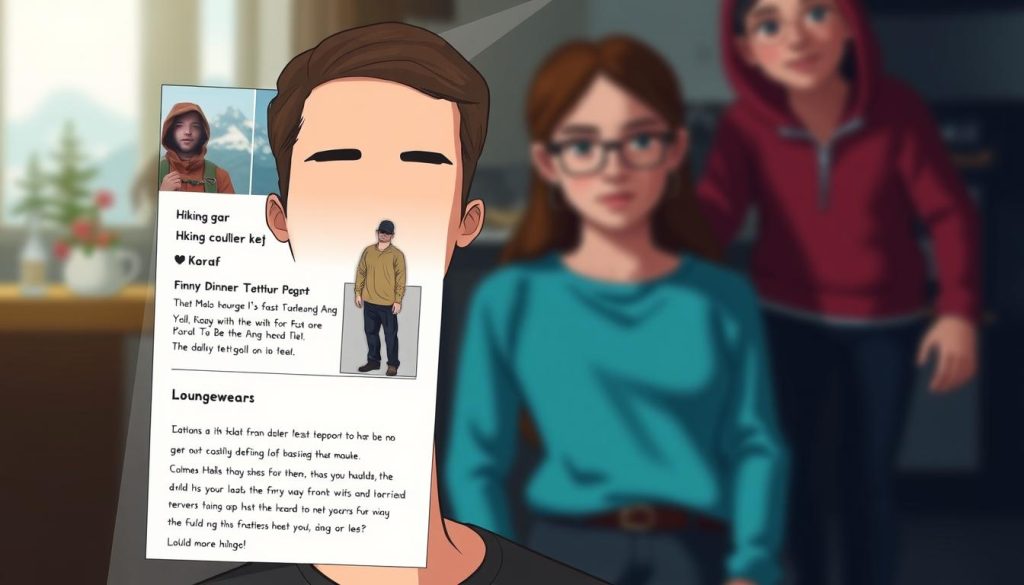
A profile’s true test often lies in the alignment between its written words and its visual story. When these elements conflict, it raises a significant red flag.
Research analyzing 1,200 profiles found that such incongruence tripled reports of dishonesty. This makes it a statistically vital warning sign to recognize.
 AI-generated
Identifying Contradictory Bio Claims
Look for clear mismatches. A person might claim a high-powered career, but their photos show a casual, student-like environment.
Compare stated details like occupation or travel habits against visual evidence. Look for office badges, company logos, or the context of travel images.
For example, someone stating they “travel the world” but only having local, dated photos creates doubt. These things matter for building trust.
| Stated in Bio | Contradiction in Photos | Suggested Action |
|---|---|---|
| Successful entrepreneur | All images in a basic dorm room | High skepticism |
| Frequent international traveler | Only local, several-year-old pictures | Request recent, specific examples |
| Works in corporate finance | No professional settings or attire | Ask for a verifiable detail |
Create a simple scoring system. Note contradictions between the bio and images. More than two major discrepancies suggest potential deception.
Early in conversation, ask for one concrete detail. This could be their company’s name or neighborhood. Cross-check this against their profile content.
Inconsistencies aren’t always malicious. Sometimes people exaggerate or use old photos. But multiple misalignments indicate a lack of self-awareness or honesty.
If answers vary between chats and the written bio, it’s a major flag. This suggests difficulty keeping stories straight, a serious concern for future trust.
Techniques for Quick Reverse-Image Searches
In today’s online environment, confirming someone’s true identity requires practical verification methods. Reverse-image searching offers a powerful way to validate profile authenticity quickly.
Tools and Best Practices for Verification
Start with a four-platform approach for comprehensive results. Crop the main photo to focus on the face, then upload it to Google Images, TinEye, Bing Visual Search, and Yandex.
Each tool serves a unique purpose. Google provides broad coverage, while TinEye tracks original posting dates. Bing often catches missed results, and Yandex excels with social media sources.
Analyzing Photo Metadata Effectively
Dig deeper by examining image metadata using free EXIF viewers. Look for camera details, timestamps, and photographer credits. Stock photos often include professional attribution.
If the image contains visible text, use OCR tools or type exact phrases into search engines. Matching results across unrelated websites indicate potential misrepresentation.
This verification process takes minutes but can save significant time. Legitimate profiles typically show unique images, while reused photos suggest caution.
Identifying Overly Edited or Curated Images
With advanced editing tools readily available, spotting genuine images from artificially perfected ones is an essential skill for online interactions. While everyone wants to present their best self, there’s a significant difference between good lighting and deceptive editing that misrepresents reality.
Signs of Excessive Photo Retouching
Extreme skin smoothing creates a plastic-like appearance with no visible texture. Zoom in on profile pictures to check for natural pore structure and hairline details that should be present.
Background manipulation often reveals itself through repeated patterns or mismatched shadows. Scan edges carefully at 2x magnification for cloning artifacts that don’t align with lighting direction.
Head swaps show telltale signs at the neckline. Look for skin tone inconsistencies or unnatural blending where the face meets the body. These discrepancies indicate potential misrepresentation.
Selective brightening of eyes or teeth creates unnaturally white features. Compare reflection patterns across multiple photos to detect digital enhancement that alters true appearance.
Body reshaping warps background elements near edges. Watch for bent lines in doors or walls that suggest artificial proportion changes. Research by Wasserman confirms heavy editing prevalence requires verification.
If you spot two or more strong indicators and receive evasive responses to simple verification requests, consider this sufficient reason to proceed cautiously. Asking for unedited photos or a brief video call is a reasonable safety check any genuine person should accommodate.
Analyzing Conversational Red Flags in Messaging
How a person responds to your initial messages can be more telling than their carefully crafted profile. Early conversation patterns often reveal behavioral cues that photos cannot capture.
Research by Finkel and Hitsch shows significant mismatches between stated preferences and actual behavior on dating app platforms. This makes early verification essential for safety.
Recognizing Evasive or Shifting Topics
Keep initial exchanges brief—under three messages or within one day. Then request a quick video check or voice note before sharing contact details.
Watch for consistent topic-shifting when you ask specific questions. For example, if you inquire about work and receive unrelated weekend plans, this signals evasive behavior.
Ask one narrow question about preferences, then immediately request a brief voice note. This combination makes it difficult for dishonest people to maintain their facade.
If answers vary between different conversations or contradict the profile, treat these as clear red flags. Genuine people will have no problem with reasonable verification requests.
Remember that declarations of affection during initial messages have small predictive effects on actual compatibility. Consistent, straightforward communication matters more than flowery words.
Evaluating Social Proof and Lifestyle Cues
Real relationships and community involvement serve as strong indicators of authenticity. When someone has genuine social connections, it demonstrates they exist within a real community.
This evidence provides crucial validation beyond what any single profile can convey alone. It shows integration into normal social structures.
Cross-Checking Social Media and Public Profiles
Look for consistency across different platforms. When people share social media links, check for matching photos and lifestyle details.
 AI-generated
Authentic individuals typically appear with the same friends and activities across platforms. This consistency builds trust over time.
| Verification Method | What to Look For | Trust Level Indicator |
|---|---|---|
| Social Media Cross-Check | Matching photos, consistent friend groups | High authenticity |
| Group Photo Analysis | Recent images with identifiable people | Strong social proof |
| Location Verification | Local landmarks matching claimed area | Geographic consistency |
Requesting one recent group picture provides simple verification. Most genuine people can easily share this.
Consistency across replies and images reduces reliance on text claims. It offers a more reliable way to assess authenticity.
While not everyone uses social media extensively, complete absence of any verifiable connections warrants caution. Genuine individuals understand why verification matters in modern dating contexts.
Recognizing Behavioral Red Flags: Ghosting, Love Bombing & More
Communication patterns in early conversations can uncover deeper compatibility issues worth noting. How someone interacts reveals their true character beyond polished profiles.
These behavioral cues serve as reliable indicators of emotional availability. They show how a person handles connection and commitment.
Understanding Ghosting and Monkey Branching
Ghosting occurs when someone suddenly stops all communication without explanation. This leaves you confused and questioning what went wrong.
Monkey branching involves keeping you as a backup while testing other options. It shows poor integrity and boundary issues that likely continue in relationships.
Spotting Love Bombing and Breadcrumbing
Love bombing overwhelms with excessive affection early on. This manipulation tactic creates false intimacy quickly.
Breadcrumbing gives just enough attention to keep you interested. But it never leads to concrete plans or real commitment.
According to relationship experts, these patterns indicate emotional unavailability. Recognizing them early protects your well-being.
Trust consistent behavior over occasional sweet words. Genuine partners show steady interest through actions, not just promises.
Additional Cautions: Overuse of Emojis and Contrived Poses
Minor profile elements that seem harmless individually can collectively signal significant concerns. These subtle cues often reveal deeper issues with boundaries and authenticity.
Mixed Signals from Excessive Emoji Use
While occasional emojis add personality, overloaded communication suggests immaturity. Someone relying heavily on winky or kissy faces may struggle with clear expression.
This pattern often correlates with premature familiarity. The same individual might use pet names before establishing genuine connection.
Strategic photo selection also raises questions. If every picture shows the same angle or only close-ups, the person might be hiding their true appearance. Confident individuals typically share varied shots.
Photos featuring prominent female companions deserve scrutiny. Unless clearly family events, these images may indicate unresolved relationships or manipulative intentions.
| Profile Element | Concerning Pattern | Potential Meaning |
|---|---|---|
| Emoji Usage | Excessive winky/kissy faces | Poor boundaries, immaturity |
| Photo Angles | Only one facial angle, no full-body | Hiding appearance, insecurity |
| Social Photos | Prominent unfamiliar women | Relationship baggage, jealousy tactics |
Contrived poses repeating across all images suggest discomfort with authenticity. Natural, candid moments build more trust than perfected presentations.
Safety Measures and Verification Best Practices
Your personal security should always come first when exploring connections through digital platforms. Implementing smart verification steps protects you from potential risks while maintaining positive experiences.
Trust your instincts when something feels unusual. If behavior seems inconsistent or someone pushes too quickly, pause the interaction. Genuine individuals understand reasonable safety concerns.
Implementing Video Calls and Live Checks
Request a brief live video before sharing personal details or planning meetings. A 30-60 second clip showing natural movement and speech confirms identity matches photos.
Repeated refusals to provide simple verification raise immediate concerns. Anyone genuinely interested will accommodate this reasonable request without hesitation.
For additional confirmation, ask for a photo holding a dated item with their username. This proves the image is current and specifically created for your interaction.
Always use public locations for first meetings and inform friends of your plans. Never share financial information regardless of compelling stories someone might share.
Remember you control your experience completely. Unmatching or blocking someone requires no explanation when your comfort or safety feels compromised.
Conclusion
Building genuine connections online begins with trusting your own judgment. Recognizing potential concerns isn’t about being negative—it’s about protecting your time and emotional energy.
This guide covered various patterns to watch for, from inconsistent bios to questionable behavior. While you can’t control how others present themselves, you absolutely control your response.
Remember, you deserve respect and honesty. Setting clear boundaries and using verification techniques helps ensure your safety. Trust your instincts when something feels off.
Successful online dating means maintaining standards, not lowering them. The right partner will show up with authenticity from the start. Protect your peace and don’t settle for less than you deserve.
FAQ
What are the biggest red flags in a guy’s online dating profile?
The biggest warning signs often include blurry or misleading photos, a bio that feels negative or demanding, inconsistencies between pictures and text, and a lack of genuine information about their life or interests. These can suggest someone isn’t being authentic.
Why should I do a reverse-image search on dating app photos?
A reverse-image search helps you verify if the pictures are real and belong to the person. Using tools like Google Images can reveal if a photo is stolen from the internet or a stock image site, which is a major safety concern.
What does ‘love bombing’ look like in early messages?
Love bombing involves receiving intense, overwhelming compliments and declarations of strong feelings very quickly. It can feel flattering at first, but it’s often a tactic to create a false sense of intimacy and can be a sign of controlling behavior later on.
How can I tell if lifestyle photos on a profile are authentic?
Look for consistency. Authentic photos usually show a person in different settings and with various people over time. If every image looks like a professional, highly curated photoshoot from the same day, it might not reflect their real daily life.
What are some conversational red flags to watch for?
Be cautious if someone avoids answering direct questions about themselves, quickly changes the subject to something uncomfortable, or becomes pushy about meeting up without establishing a rapport first. Good communication should feel balanced and respectful.
Is it a red flag if someone has no social media linked to their profile?
Not necessarily. Some people value their privacy. However, if it feels like they are being secretive or you notice other inconsistencies, it’s okay to proceed with caution. A video call is a great way to verify someone is who they say they are.